About me

I am a 4th year PhD candidate at CREST, ENSAE Paris, Institut Polytechnique de Paris under the supervision of Pierre Boyer and Michael Visser since September 2022. I visited the University of California, Berkeley, hosted by Emmanuel Saez during the 2025 Spring semester.

My research lies in the field of Public Economics and especially taxation where I combine both theoretical and applied approaches. I am also very interested in Political Science and Social Choice.

Contact: theo.valentin@ensae.fr

Working papers

  • Non-linear Corporate Income Tax: Learning, Intensive and Extensive Margins
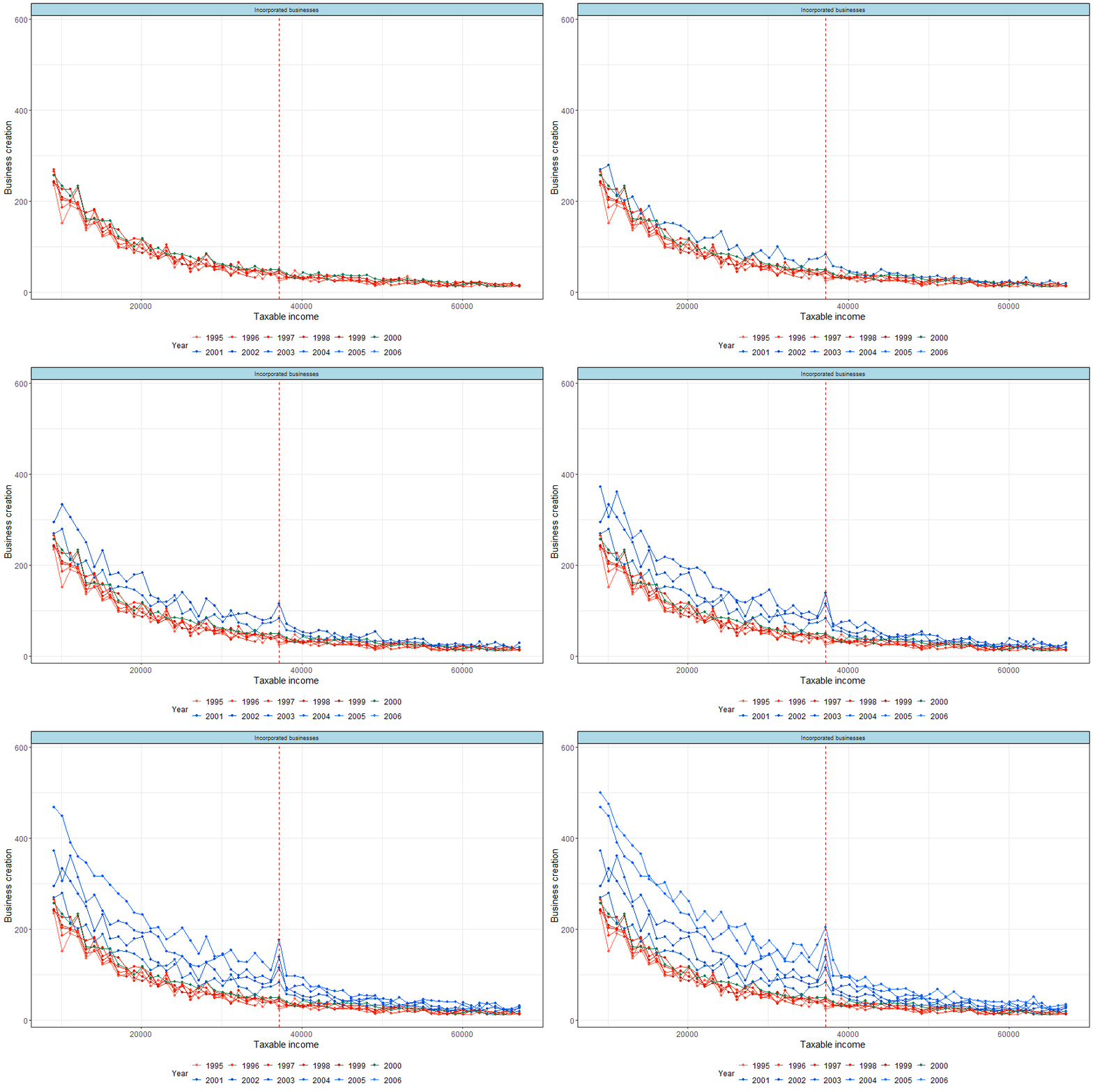
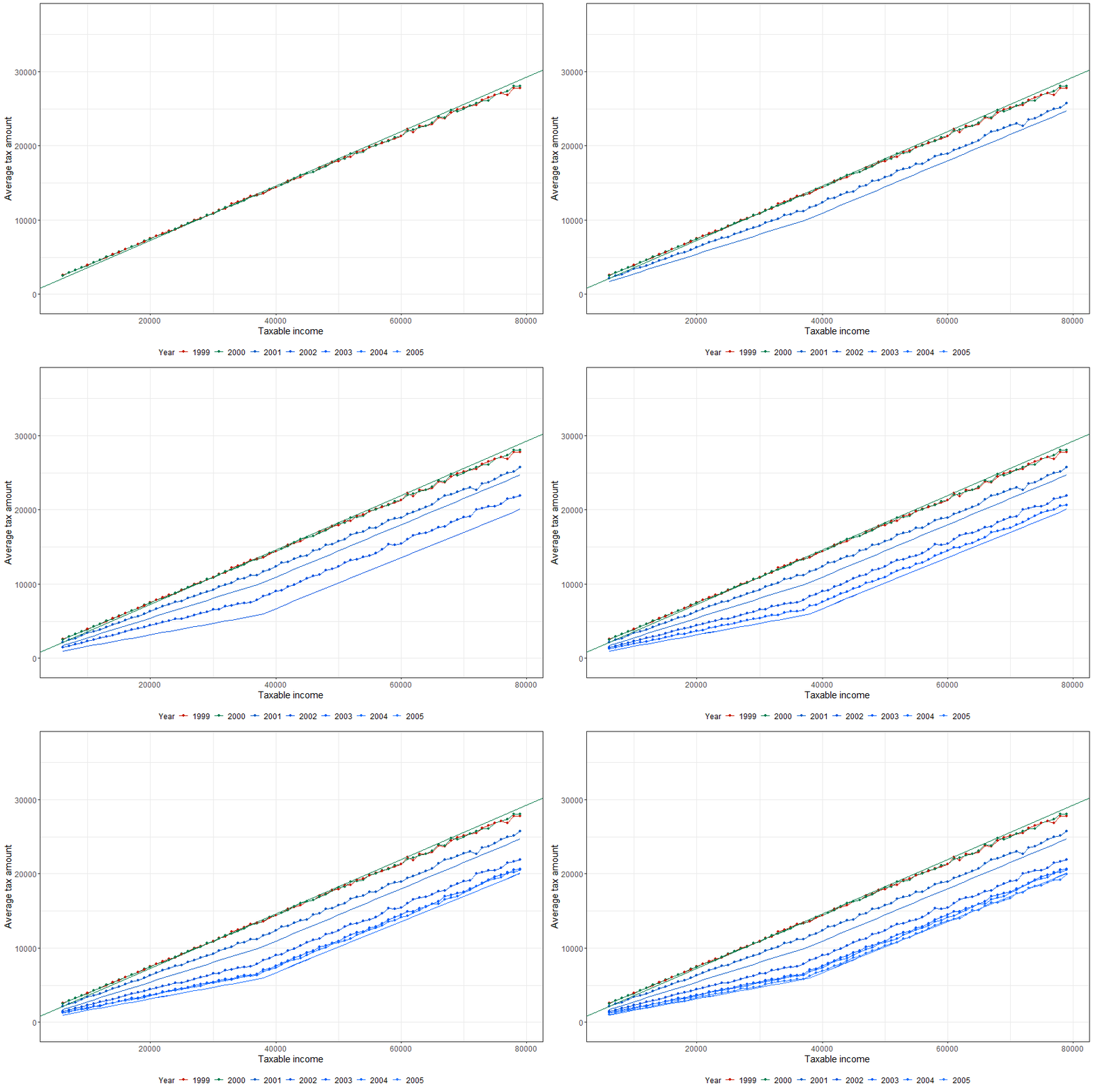
    The welfare implications of corporate tax reforms are made unclear by the variety of effects they generate. This paper estimates both the effect of frictions, especially attention, on the corporate taxable income elasticity and the business creation effect of corporate tax reforms. I study a reform in France that replaced the existing flat corporate income tax with a threshold-based two-rates progressive system. I rely on detailed administrative tax data and exploit a unique institutional feature, the reported tax amount. First, I infer that at most 19% of firms are inattentive to tax reforms, i.e. they use the pre-reform tax code instead of the current one. This implies a cost of inattention of 1.8% of their taxable income. Second, I exploit the excess mass at the threshold to estimate the elasticity and show that overall frictions attenuate it by 39% in the short-run. Third, I find a sizeable positive business creation effect of the reform. Using a two-way fixed effects PPML event-study design combined with treatment intensity variation at the county level, I estimate an average treatment effect of 15%. However, unincorporated businesses reacted to the lower average corporate tax rate by incorporating and by splitting revenues across multiple entities. This creates a pure tax revenue loss. Although this response is highly sensitive, rising by 45%, its magnitude remains limited. Overall, the welfare gains of moving from a linear corporate income tax to a progressive schedule are driven by business entry.

Paper presented at: UC Berkeley Public Finance Seminar (Berkeley, 2025), Center for Business Taxation Doctoral Conference (Oxford, 2025), UC Santa Barbara Brown Bag Seminar (Santa Barbara, 2025), University of Utah Lunch Seminar (Salt Lake City, 2025), EEA (Bordeaux, 2025), PSE Applied Economics Seminar (Paris, 2024), CESifo Public Economics Area Conference (Munich, 2024), ZEW Public Finance Conference (Mannheim 2024), The 80th Annual Congress of the International Institute of Public Finance (Prague, 2024)
  • Taxing Digital Addiction
    Social media consumption relies on users’ behavioral biases while also generating negative externalities, like tobacco and alcohol do, yet as opposed to these goods they are largely untaxed. This paper develops a model of optimal taxation of a monopoly platform running a social media that jointly invests in an addictive technology and sets its ad-load. While generating consumer surplus, the social media harms users through overconsumption from addiction and harms non-users through negative consumption externalities. Because addiction investment is observable only by the platform, the social planner relies on a tax on total engagement as an indirect corrective instrument. A key friction is that the platform can offset the tax by adjusting its ad-load, limiting its effectiveness. I characterize the optimal tax through a sufficient statistics formula: the tax equals a welfare-weighted sum of the elasticities of addiction, ad-load and engagement to the tax. When the welfare gains of reducing addiction are large, the tax rate reaches its upper bound through the platform’s participation constraint and the social planner optimally extracts all platform surplus.

  • Charitable Giving, Tax Design, and Tax Consent, with G. Fack, B. Garbinti, J. Goupille-Lebret
    In this paper, we examine how the design of tax incentives for charitable giving influences donation behavior, and how non-monetary motives shape these responses. We focus on the French context, where a wealth tax has existed for several decades, and exploit multiple reforms that altered the marginal tax price of charitable gifts for wealth taxpayers. Our analysis draws on rich French administrative panel data linking the universe of income tax returns with the universe of wealth tax returns. We document strong heterogeneity in charitable giving behavior between wealth taxpayers and those subject only to the income tax, and we develop a conceptual framework to rationalize this finding. Using tax variation induced by the reforms, we study the main channels driving behavioral responses. First, we find evidence of a strong attachment to charities: despite being able to benefit from a lower marginal price of gifts, many wealth taxpayers deliberately continue to pay the higher marginal price. Finally, when individuals lose eligibility for the wealth tax credit, we observe limited substitution toward the income tax credit, which suggests differential tax aversion depending on the tax base to which the incentive applies.

Selected work in progress

  • Optimal Corporate Taxation with Welfare Weights

Non-academic Publications & Papers

Curriculum Vitae

If the PDF viewer doesn’t load, you can download it here.

TA sessions

  • Econometrics 2, ENSAE Paris, Pr. Michael Visser (Graduate level, Spring 2023)
  • Econometrics - 3A CI/MS, ENSAE Paris, Pr. Bertrand Garbinti (Graduate level, Fall 2022)
  • Econometrics 1, ENSAE Paris, Pr. Xavier d’Haultfoeuille (Graduate level, Fall 2022)
  • Industrial Organization, Université Paris Descartes, (Undergraduate level, Spring 2021)